
Cyberman Helmet Replica
As seen in Doctor Who in 1967 (The Moonbase/Tomb of the Cybermen)

This was my first project as an official student of Model Making Effects. I chose to do this project as part of the 'History & Replication' module at university. This module was set for students to research the history of a prop or model and how it was originally made. The practical asset was to be a replica of said model made using the same techniques as how it was made for film or television.
I presented a few ideas which included a different model of the Cyberman head as seen in 'The Invasion' (1968). However, the tutor and I agreed on the 'Moonbase' helmet because they were the more iconic design from the 60's, in fact I think they still are. They were even used for publicity photographs at a bus stop and a telephone box.

The Moonbase (February-March 1967)

The Tomb of the Cybermen (September 1967)


Examples of publicity shots featuring the Cybermen in 1967. Unsure where the phone box one was taken, however, I do know the bus stop is in Ealing.
"You belong to us. You shall be like us" ~ Cyber Controller
About the Cybermen
So a bit of background about the Cybermen, for those not in the know. Sorry in advance but I am a nerd about these things.
The Cybermen were a realistic idea created by Doctor Kit Pedler. One of Pedler's greatest fears as a Doctor was 'dehumanising medicine', in which spare-part surgery reached the stage where there was barely, if any Humanity left.
"I asked Kit [Pedler] what his greatest phobia was as a doctor. 'Dehumanising medicine,' he answered. 'You start with artificial arms and legs - very necessary and beneficial - but what if medical science eventually makes it possible to replace all of a human's organs - heart, lungs, stomach - with metal and plastic replacements? At what stage would that person stop feeling human emotions and become robotic?'
"'That's it,' I said. 'Men with everything replaced by cybernetics, lacking the human feelings of love, pity, mercy, fear, compassion - and invulnerable to cold or heat. What terrible adversaries they would make! Cybernetic men. Cybermen!'."
- Gerry Davis ("Doctor Who: Cybermen", 1988)
They first appear in 'The Tenth Planet' (1966), which also sees the end of the first Doctor (William Hartnell). These Cybermen come from Earth's lost twin, Mondas, however, in later stories it is revealed that Cybermen are born wherever there is life. The Cybermen are a result of 'parallel evolution', for example, in the Doctor Who Comic Strip 'The World Shapers', creatures called the Voord are revealed to be evolving into Cybermen. Later, in 2006, the Cybermen return after a 16 year hiatus. This time, the Cybermen are created on an alternate version of Earth, by a dying genius. In this story, the only organic component of a Cyberman is the brain.
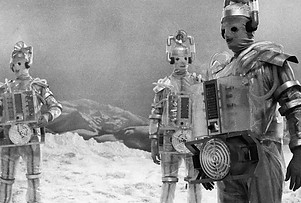
The Tenth Planet (1966)

The World Shapers (1987)

Rise of the Cybermen (2006)
Research
To learn and understand how the Cybermen were visually brought to life, I looked at books that featured behind the scenes articles on how Doctor Who was made. For example, 'Doctor Who: A Book of Monsters' is a great read for any monster maker, I think. Along with the Doctor Who Technical Manual, which provides accurate plans of various Doctor Who props, models and costumes. I used the Technical Manual to finalise the front and side proportions of the helmet.
I also looked at The Prop Gallery to expand my research. The Cyberman helmet was designed by costume designers, Sandra Reid & Mary Woods and was produced by Bill King of Trading Post, a freelance company largely involved in boat building while also manufacturing fibreglass products for film & television.
From my research, I learned that the Cyberman helmet was fully constructed from Fibreglass. The rods on either side of the helmet were clear flexible tubing with solid perspex pieces at the top and bottom to form a curved shape. A black elastic loop was positioned within the helmet to hold the torch at the front in place. The facial features are framed with thick silver foil and the circular eye holes contain a black sheet of mesh.
The helmet was built in two parts, a backplate was made separately to allow an easy fitting for the actors. The backplate was attached with hooks and clips.


Original 'Moonbase'/'Tomb' Cyberman helmet found here: https://www.thepropgallery.com/cyberman-helmet-tomb-of-the-cybermen
Making the Cyberman Helmet
As mentioned earlier, I started this project by using the Cyberman front and side profiles from the Technical Manual to finalise the overall dimensions of the helmet. I did this by scanning and enlarging the page, printing out copies until I was happy with the dimensions.


I drew the templates onto a block of foam and spent a week or so carving away at that until the shape of the material resembled the helmet accurately enough for the application of clay later. While carving, the foam was split into three parts - the main body of the head, the top section and the thick ring separating the two. This was to enable an easier sand and smoothing process and avoid complicated challenges such as sanding the ring while it was attached to the head.
The carving was then smothered in a sheet of clay, which deformed the shape of the head. So the moulding process continued in order to capture an almost if not exact likeness to the original prop, which was observed frequently during this process. Once the basic form was done, the final addition was applying the semi-circular tubing on both sides of the top section.
Next was the Fibreglass method, which took longer than it should have due to a seemingly endless series of errors. This was my first time practicing the technique. I added shimming to the clay helmet so the Fibreglass mould could be split into four parts which would later be bolted together. I then used the Fibreglass mould to make a solid Cyberman helmet out of the same material, which, again because I was new to the method, took a couple of attempts. But you've got to look at mistakes in a positive light, mistakes are a learning tool. As long as you keep trying mistakes are just pitstops towards success.
So I had the fibreglass Cyberman head. The next thing was a lot of sanding and filler work to make sure the helmet was smooth and nice to look at, no cracks or crevices that would show up in the paintwork later. Filler Primer is a very useful paint for this process as it gives away areas that need attention and also helps hide tiny crevices.
The ear rods were made using clear acrylic tubing which were bent using a heat gun and wooden template shaped accurately to the original prop. The mid sections were given a frosted look by sandblaster.
Back to the helmet, once it was smooth, clean and primed, the facial features were drawn and cut into and a day was then spent applying silver paintwork (Halfords: Ford, Moondust Silver). Once the many layers of paint were dry, the final additions were carefully applied, the rods, the silver foil, mesh and head light.

Fibreglass: What NOT to do
-
Don't forget to keep moisturising the clay and keep it in a cool or damp environment to avoid cracks.
-
Don't put less than enough catalyst into the Gelcoat mix otherwise your mould will not cure properly
-
Don't put too much catalyst into the Gelcoat or Resin Mix! This could cause the mixture and/or the mould to overheat and cause fire. You will know if this situation occurs when you hear the mould cracking up, turning purple and smoke rising from the mould.
-
Check if the catalyst is good to use. Otherwise you could apply Gelcoat and be waiting hours for it to cure!
NOTE: I did NOT cause any fire during this project, such an incident was prevented in time. I have since practiced and improved my skills in Fibreglass methods and I hope you are all safe with your moulding processes.
Correct Catalyst Mixture e.g. Catalyst = 300ml (Gelcoat) x 2% = 6ml
Finished Product


